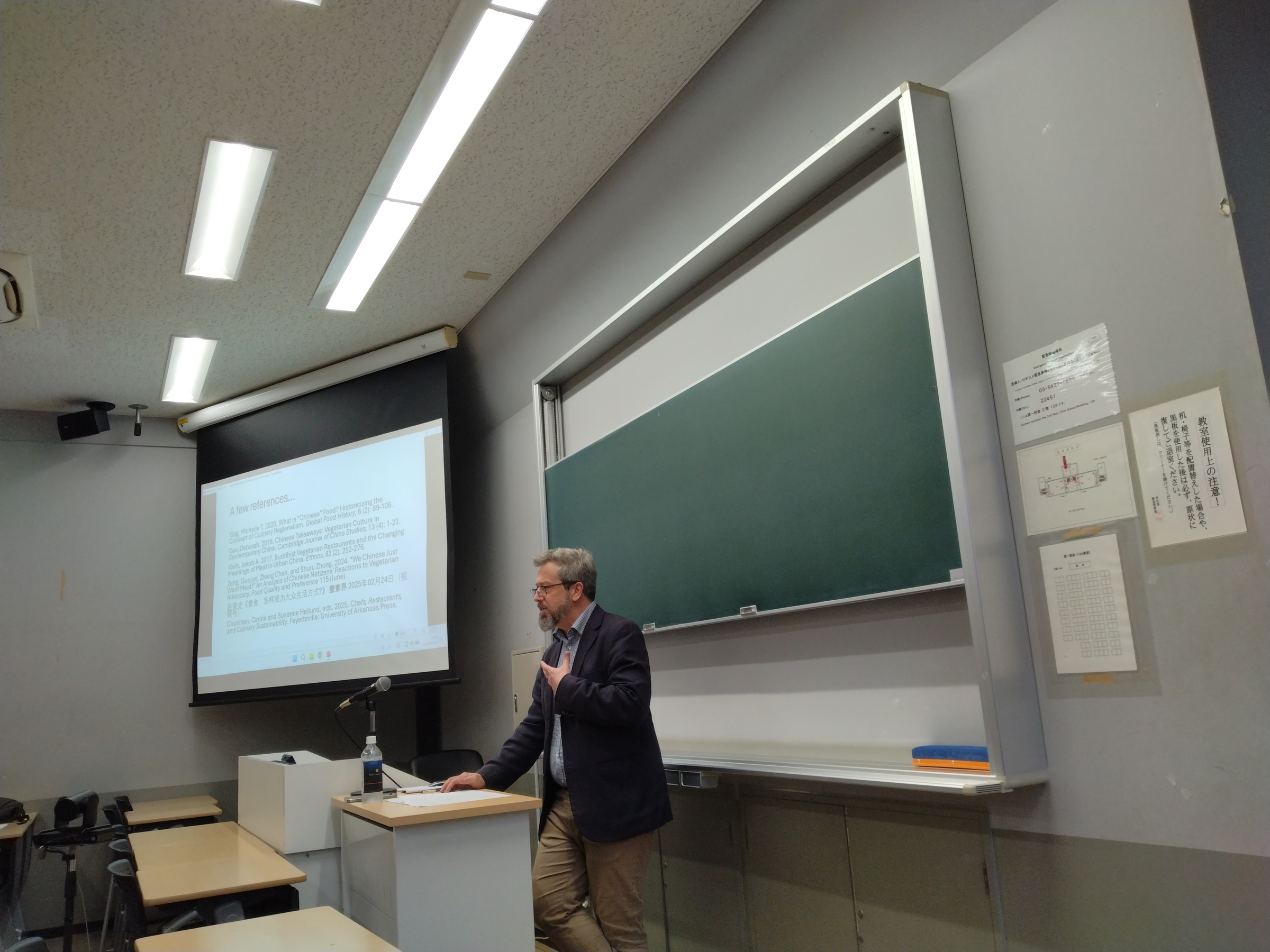
On Monday, June 8, 2026, at Keio University’s Mita Campus, a lecture titled “Vegetarianism and Culinary Regionalism in Eastern China” was held as a study meeting of the Center for Contemporary Chinese Studies, Institute of East Asian Studies. The speaker was Jakob Klein, Associate Professor of Social Anthropology and Deputy Director of the Food Studies Centre at the School of Oriental and African Studies (SOAS), University of London.
The session was chaired by Professor Kazuhiro Iwama of the Faculty of Letters, Keio University, with Professor Sidney C. H. Cheung of the Department of Anthropology, The Chinese University of Hong Kong, serving as commentator. The lecture was based on a total of two months of fieldwork conducted from August to September 2025 and from April to May 2026.
Introduction
Klein began by stating the purpose of the lecture. Drawing on the argument of American historian of Chinese food Michelle King, namely, a perspective that asks about the dynamics of “culinary regionalism,” or how locally rooted forms of cuisine are created, rather than geographically classifying Chinese cuisine, he examined the relationship between vegetarianism and regionalism in contemporary China.
Since the 2000s, vegetarian restaurants have rapidly increased in urban China and have been discussed in connection with the revival of popular Buddhism and the growing interest of the urban middle class in food safety, health, and the environment. However, insufficient scholarly attention has been paid to what kinds of dishes these restaurants actually serve.
Some studies have criticized advocates of vegetarianism in China for remaining at the level of abstract moral arguments and failing to engage sufficiently with the country’s rich food culture. In response, Klein argues that the scope of inquiry should be broadened beyond the activities of nonprofit organizations to include the practices carried out by restaurant owners and chefs in their daily work.
The proprietors Klein studied did not call themselves advocates of vegetarianism, but they linked ethical goals concerning health, the environment, and traditional culture to their practices as entrepreneurs. These projects are also culinary and aesthetic; while they are shaped by the dynamics of the places in which the restaurants are rooted, they simultaneously shape the food culture of those places. This perspective runs throughout the lecture.
The field sites were two contrasting locations in the lower Yangtze River region (“Jiangnan”): Hangzhou, the capital of Zhejiang Province, and Mount Jiuhua, a Buddhist pilgrimage site in Anhui Province.
Hangzhou: Beyond Regional Cuisine and the “Gourmet Desert”
Klein begins with his experience at the upscale vegetarian restaurant “Puzhu”, which is reminiscent of a bamboo grove. With the founder, Mr. Cheng, present, he sampled a course of nine dishes, and before each dish was prepared, the ingredients were shown in their actual form and explained. In the appetizer “Eight Immortals of the Water,” wetland ingredients such as water caltrop were used, while in a matsutake dish, raw slices were served before noodles in broth; in both cases, the emphasis was on tasting the ingredients’ own “original flavor”. No chemical seasonings are used, and the menu is changed frequently in accordance with the twenty-four solar terms.
In Chinese, dishes that do not use meat are generally called sushi 素食 a term with Buddhist associations. By contrast, hunshi 荤食 implies not only meat eating but also the use of alcohol and the “five pungent vegetables” (alliums). In Buddhist vegetarian cuisine, “mock meat,” in which wheat gluten or tofu is used to imitate the texture of meat, has developed, but Puzhu avoids this, uses wine and alliums as well, and calls its food “plant cuisine,” free from the very distinction between “vegetarian” and “non-vegetarian.”
Ingredients are also sourced from across the country, including tomatoes from near Beijing and mushrooms from Yunnan Province, and Klein describes its aesthetic as an international style of upscale vegetarian cuisine found from Tokyo to London. Cheng is said to have remarked, “Just because we are in Hangzhou does not mean we have to make Hangzhou cuisine.”
Nevertheless, restaurants like this are also part of Hangzhou’s lineage of vegetarian restaurants. Since the Southern Song moved its capital there in the twelfth century, Hangzhou has had a gastronomic tradition in which northern and southern food cultures merged, and in which a “light and delicate” taste that brings out the ingredients’ “original flavor” is regarded as a virtue. In temples around West Lake, Buddhist vegetarian cuisine developed dishes that remain popular today, including mock meat dishes such as “vegetarian roast goose,” made with tofu skins, and “vegetarian Dongpo pork,” modeled on braised pork.
In recent years, however, Hangzhou’s cuisine has lost so much of its reputation that it is derided by some as a “gourmet desert”, due to tourism development and commercialization, as well as the decline of home cooking caused by the “996” work schedule (9:00 a.m. to 9:00 p.m., six days a week) that drives young people hard. Klein notes that many of the city’s vegetarian restaurants, currently numbering 80 to 100, have emerged in response to this discourse of “decline.”
A representative example is “Qingchun Pumen” in the Lingyin Temple area. Founded in 2019, it has already expanded to several cities and is crowded with young people and families. According to a regular customer, after the COVID pandemic, people came to favor health over stimulating flavors. The restaurant uses no alliums and serves no alcohol, but deliberately presents itself as serving not sushi (Buddhist vegetarian food) but “plant-based food,” emphasizing that it is a place open to all, regardless of religion. More than half of its ingredients are said to be certified organic and sourced from places including Yunnan Province. [Figure 1]
![[Figure 1] Qingchun Pumen in Hangzhou](/assets/img/articles/klein-figure-01.jpg)
Mount Jiuhua: A Mountain of Pilgrimage and Locally Rooted Vegetarian Cuisine
The second field site, Mount Jiuhua, lies about 200 kilometers west of Hangzhou in southern Anhui Province. It is one of the four sacred mountains of Chinese Buddhism, established as a sacred place of Ksitigarbha Bodhisattva (Chinese: Dizang Pusa 地藏菩萨) in the late Ming period, and the monk Jin Qiaojue, who came from Silla in the eighth century and died on the mountain, has been venerated as “Jin Dizang.” In recent years, with the opening of new roads and high speed rail, pilgrimage and tourism have developed rapidly; much farmland has been converted to tourism infrastructure, and many former farmers have moved into food service and tourism. [Figure 2]
![[Figure 2] Mount Jiuhua](/assets/img/articles/klein-figure-02.jpg)
At the foot of the mountain, “Bencaoxiang” is a restaurant opened in 2019 by the Shen sisters, who grew up locally. On the festival on the fifteenth day of the seventh lunar month, a free vegetarian buffet is served after the Buddhist service, offering homestyle dishes such as stewed chestnuts and mushrooms. According to Ms. Shen, ingredients are the most important consideration: they should be healthy, seasonal, locally produced, free of toxins, and “pure.”
Meat is avoided not only because of the precept against taking life, but also because animals release toxins when slaughtered, making the meat itself “poisonous.” Ms. Shen herself acknowledged that most visitors to Mount Jiuhua still want meat dishes.
In fact, most eateries on Mount Jiuhua are small family run businesses offering almost identical menus of meat dishes labeled “Qingyang cuisine” or “Hui cuisine.” Compared with Hangzhou, the food is characterized by salty, rich seasoning with more oil and chili peppers, and local specialties include fermented foods known for their distinctive smells, such as “stinky mandarin fish” and “hairy tofu”. In recent years, however, flavors have become milder for tourists, and household fermentation culture is also said to be disappearing as people increasingly rely on ready-made seasonings.
Against this background, at the more upscale “Sanjieyuan”, head chef Mr. Yao characterizes mainstream meat restaurants as the oil and flavor heavy “old Hui school” and differentiates his own “health preserving, light and delicate” cuisine as the “new Hui school.” At the same time, he criticized vegetarian cuisine in large cities such as Hangzhou as a “vagabond (jianghu 江湖) cuisine,” lacking regional character.
At the resort “Wuxi Shanse”, part of a group of formerly state-owned enterprises, meanwhile, Mr. Wang, a disciple of an inheritor of intangible cultural heritage, takes pride in his homemade mock meat dish “mock pork intestine,” made exclusively from local ingredients. It embodies a form of upscale vegetarian cuisine different from that of Puzhu, rooted in a banquet culture centered on meat.
An indispensable ingredient in local cuisine is the medicinal rhizome huangjing (Solomon’s seal rhizome). It is also called “Ksitigarbha huangjing” (Dizang huangjing) because of the legend that Jin Dizang practiced asceticism while eating only this plant and that his body did not decay even after he died. Klein explained that it is an ingredient at the core of the identity of local vegetarian restaurants, linked to the local soil and water and the spiritual energy of the mountain.
Conclusion: Movement Across Regions and Cuisine as a Language
Finally, Klein compared the two cases and organized the implications that could be drawn from them.
Vegetarian restaurants in the international city of Hangzhou do not position themselves within “Hangzhou cuisine,” instead incorporating national and international cooking styles. Rather than representing a loss of regionality, this is a response to a cosmopolitan clientele and to Hangzhou’s reputation as a “gourmet desert.” By contrast, the people responsible for cuisine on Mount Jiuhua tend strongly to see themselves as rooted in local culinary traditions. Their approaches show diversity: Bencaoxiang places emphasis on preserving local traditions, Sanjieyuan on refining these traditions, and Wuxi Shanse on innovation within the framework of master disciple transmission. Yet in all cases, chefs’ training histories and flows of capital are supported by movement across regions, such as experience in other provinces and return migration from the cities back to their hometowns.
The ways in which the “seasonality” of ingredients was discussed were also contrasting. Hangzhou gathers ingredients from “pure” places across the country, such as Yunnan and Fujian, thereby creating, as it were, an idealized view of nature on a national scale. On Mount Jiuhua, by contrast, “seasonal” ingredients mean “local” ingredients, and attachment to specialties linked to the local soil and water and the mountain’s spiritual energy is emphasized. In both cases, however, a Chinese medical idea of harmonizing body and environment through food lies at the foundation, and both share an effort to restore a relationship with “place” that has been disrupted by rapid urbanization and climate change.
Klein argues that the conventional frameworks of environmental determinism and identity formation rooted in place alone are insufficient to fully understand culinary regionalism in contemporary China. As commentator Sidney C. H. Cheung has shown in his research on Huaiyang and Shanghai cuisine in Hong Kong, Klein argued that attention must also be paid to the movement of people, food, and capital across regions.
At the end of the lecture, he pointed out that the “language” of local cuisine can be a powerful means of discussing social issues such as food safety and the rupture of tradition between generations. He concluded by stating that practices addressing these issues can also have concrete effects on changes in cuisine itself.
Questions and Answers
In the question and answer session following the lecture, commentator Sidney C. H. Cheung first offered comments based on his experience in Hong Kong and Guangdong. He pointed out that the boundaries of “what counts as vegetarian” differ by region. In Cantonese vegetarian cuisine, for example, there is a custom of eating “vegetarian” dishes containing oysters at Lunar New Year because juvenile oysters were once cultivated on bamboo fences.
He then asked three questions: (1) how traditional and religious vegetarian practices are being carried on within contemporary, cosmopolitan vegetarian consumption; (2) whether flexible vegetarian practices such as “it is fine if the meat itself is not visible, even in meat broth” can be considered a distinctively Chinese characteristic, and whether there are differences between Hangzhou and Mount Jiuhua; and (3) whether Chinese forms of vegetarianism have also been influenced by veganism originating in the West and similar movements.
Wang Chudi, a fourth year student in the Faculty of Letters at Keio University, also mentioned this kind of “flexibility,” giving the example of a friend whose mother is a devout Buddhist: no meat is eaten at home, but the friend eats meat normally at school.
Next, Associate Professor Tatsuya Mitsuda of the Faculty of Economics focused on the restaurant as a “space” in which people from various positions act and discuss matters concerning “authenticity” and “healthfulness.” He asked whether this constitutes a new way of distinguishing religious vegetarianism from secular vegetarianism, and how flows of ingredients, capital, and ideas spread through this space across multiple scales of the local, national, and global.
Zhu Jingjing, a first year master’s student in the Graduate School of Letters, noted that many of the ingredients came from Yunnan Province and asked about the possibility of conducting fieldwork in restaurants in Yunnan.
Professor Kazuhiro Iwama of the Faculty of Letters asked whether it was appropriate for the garden at Puzhu to be described as a “Japanese style garden,” and also asked about the analytical frameworks of “environmental determinism” and “identity formation” mentioned in the lecture.
In response, Klein first discussed Yunnan cuisine. He explained how, through events such as the international exposition held in Kunming in 1999 and cuisine campaigns by Yunnan Province since 2009, Yunnan’s former image as “poor and backward” has been strategically transformed into a symbol of being “healthy and pure” and therefore advanced. He added that he himself had conducted a total of about six to eight months of research in Yunnan.
Regarding the garden, he recounted an episode in which he told the manager who was guiding him, “This is a Japanese style garden,” only to be corrected: “No, this is in the Song dynasty style,” leading to a dispute touching on nationalism. He said that the term “plant cuisine” itself is not entirely without Japanese connotations, but that “plausible deniability,” in which such connections are deliberately left unstated, often operates.
This “plausible deniability” also extends to questions of religion. Since 2017, amid stronger crackdowns on temples and other institutions using religion for commercial purposes, many vegetarian restaurant owners, despite holding deep religious beliefs, do not foreground them, instead describing their activities in secular terms such as health, the environment, and traditional culture. Yet religiosity remains visible in many places, including the tendency of restaurants to cluster near temples. Klein also gave the example of a vegetarian expo in Shanghai where, despite the complete absence of religious symbols, several participants introduced one another as “fellow believers.”
Regarding flexible vegetarianism, he explained that although vegetarian and vegan practices are in fact flexible in places such as the United Kingdom, there is an underlying assumption there that one should be “consistent.” By contrast, in Chinese lay Buddhism, practices such as abstaining from meat for only ten days each month are themselves affirmed as acts for accumulating merit.
At the same time, in recent years some new vegetarian restaurants have deliberately emphasized consistent practice and sought to create “safe spaces” where vegetarians can dine together without concern, and he cited an owner in Shaoxing who runs such a restaurant. Regarding the relationship with the West, he added that while more upscale restaurants incorporate cuisines from multiple countries and embody cosmopolitan vegetarian practices, they are also supported by a looser demand from customers who are not necessarily consistent vegetarians but enjoy internationally diverse vegetarian food several times a month.
Finally, he stated that the two analytical frameworks of environmental determinism and identity formation were based on the work of food culture historian Zhao Rongguang, Michelle King, and others. He then reiterated the lecture’s conclusion that it is also necessary to attend to the “movement” of people, food, and capital, and to the fact that cuisine can simultaneously operate on multiple scales: regional, national, and international.
(Recorded by Zhu Jingjing / Master’s Program, Graduate School of Letters, Keio University)
Speaker and Participant Profiles

Share & Reference