
Summary
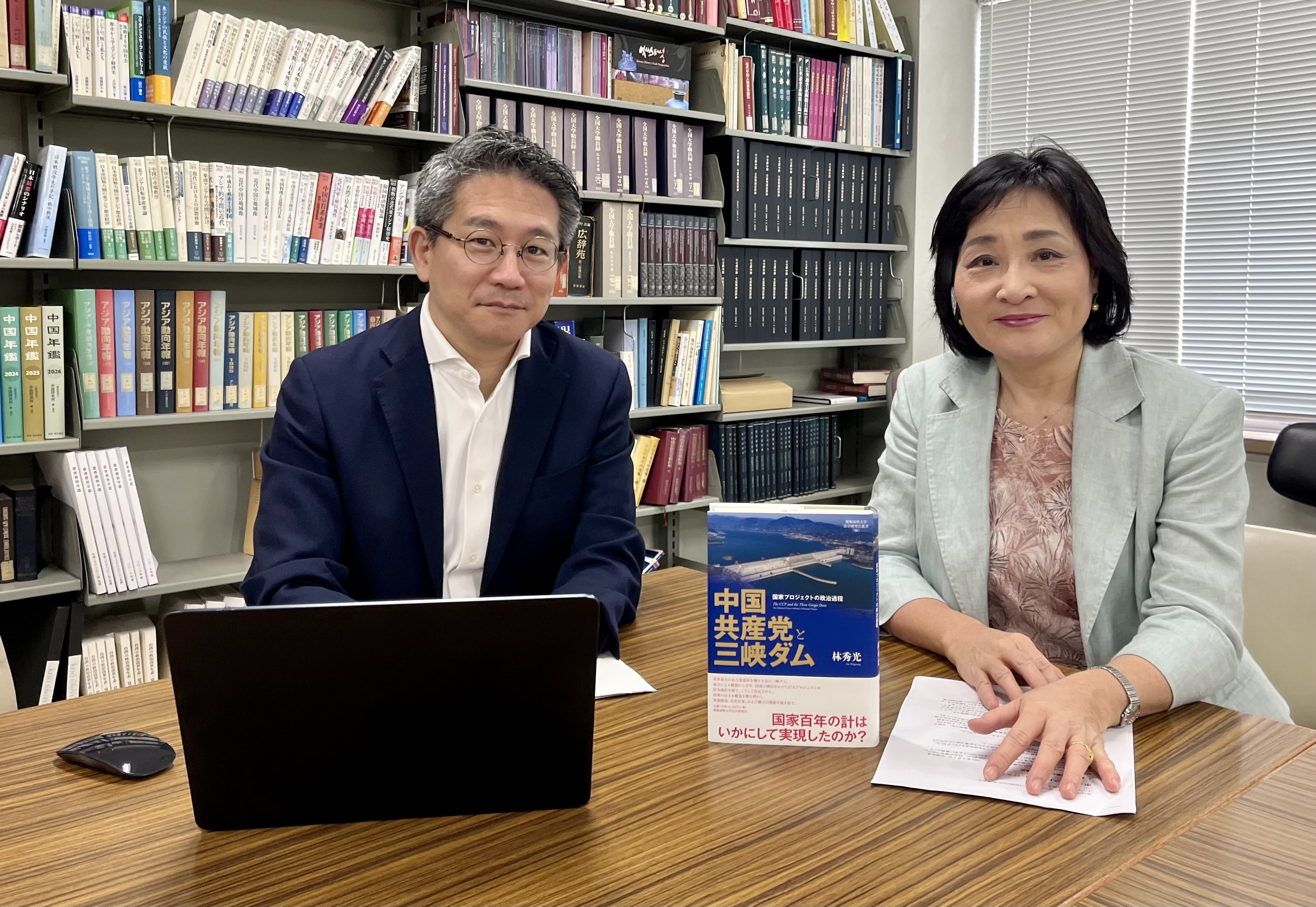
Why did the plan for a single dam require a vote by the National People’s Congress (NPC), China’s highest organ of state power? In this episode, we welcome Professor Xiuguang Lin of the Faculty of Law at Keio University to discuss her book The CCP and the Three Gorges Dam: The Political Process behind a National Project (Keio University Press, 2025).
A news story she encountered while searching for an undergraduate thesis topic eventually developed into the central subject of her academic career. By tracing the twists and turns of the Three Gorges Dam project over nearly a century, how did Lin move beyond established frameworks in the study of Chinese politics? What questions does she hope to explore next? Our conversation covers the origins of her research, the story behind the book, and the questions that remain unanswered even after its completion.
Why the National People’s Congress? A Question Sparked by a News Story
On April 3, 1992, the Three Gorges Dam plan, a massive national project, was approved by the National People’s Congress. At the time, it was highly unusual in Chinese politics for a specific individual project to be submitted to an NPC vote. The decision therefore received extensive media coverage in Japan as well.
Lin was then searching for an undergraduate thesis topic in Professor Ryosei Kokubun’s seminar at Keio University. She recalls being deeply struck by the news. What captured her attention, however, was not the dam itself. It was a straightforward question: “Why did this project require a formal decision by China’s highest organ of state power?”
This simple question about the dynamics of power in China became the starting point of her research and eventually developed into a lifelong academic pursuit.
Tracing a Century of Twists and Turns: Beyond Fragmented Authoritarianism
The book makes two major academic contributions.
First, it provides an empirical account of the Three Gorges Dam as a policy-making process, tracing the project’s long and complicated history from Sun Yat-sen’s original proposal in 1918 to its approval in 1992. Rather than merely reconstructing the project’s history, Lin focuses on cooperation between Party-member technical cadres in the government departments responsible for the project and the top leaders who supported it. By carefully examining the selection of the dam site and reservoir level, she identifies paradigm shifts within the policy process. She also demonstrates the power involved in reallocating resources and risks associated with flood control, power generation, and navigation along the Yangtze River.
Second, the book seeks to move beyond the fragmented authoritarianism model developed by Michel Oksenberg and other scholars, a standard framework in studies of Chinese policy-making. This model emphasizes how conflicts of interest among bureaucratic departments can impede policy decisions. According to Lin, however, its analysis of the Three Gorges project was based primarily on developments through 1986, when the project stalled.
By extending the analysis to the final decision in 1992, the book explains how interdepartmental friction was overcome in the face of broader “national visions,” including flood control in the middle and lower reaches of the Yangtze River and plans to quadruple the national economy and electricity supply. In doing so, it reveals the structures through which policy decisions ultimately become possible.
The NPC decision also carried another political meaning. It defined the dam as “a project for the entire nation” and legitimized a system under which a construction levy was added to electricity charges across almost the whole country.
A Humanities and Social Sciences Scholar Takes on a Dam
The path of Lin’s research was far from easy. An understanding of dam construction requires technical knowledge of the natural sciences, including hydraulics, sediment accumulation, and the structural features of dam sites. For Lin, a political scientist trained in the humanities and social sciences, this was far outside her original field of expertise. Acquiring the literacy needed to interpret statistics, charts, and technical diagrams required an enormous amount of effort.
This is precisely why she offers the following advice to younger students: even those studying the humanities and social sciences should acquire a degree of scientific and technical literacy. Doing so can greatly expand the scope of their research.
At the same time, Lin describes her encounter with the Three Gorges Dam as fortunate. When she first began, she never imagined that it would become a lifelong research topic. Yet because the project spans almost a century, it offered what she calls an “ace case”—one that made it possible to move beyond narrow policy analysis and approach the very core of Chinese Communist Party rule.
Throughout the writing process, she continually asked herself whether she was making full use of such valuable material. The chance encounter with this subject nevertheless became a major force driving her to deepen her research.
What Remains Unknown after the Book Is Finished
What remains unknown even after the completion of the book? Lin answers the question candidly.
First, because of limitations in the available sources, it is still impossible to verify the details of the top leadership’s field inspection in 1986. The book therefore does not provide a complete answer to the original question: why was a decision by the National People’s Congress necessary?
The second unresolved issue concerns the dynamics of local politics. Chengdu, the capital of Sichuan Province, was reluctant to support the Three Gorges project. Chongqing, by contrast, was then still an ordinary city within Sichuan but played a major role in promoting the project. The complicated relationship between the two cities demonstrates that the relevant power structures existed not only between the central and local governments, but also within local politics itself.
Lin also identifies two broader subjects through which the research could be further developed.
The first would be to write a history of China’s international relations centered on the Three Gorges Dam. The project began with assistance from the Soviet Union and later involved countries such as the United States and Canada. Its history therefore offers a valuable perspective on China’s changing relations with the outside world.
The second would be to trace how the water resources and electric power bureaucracy that oversaw dam construction was repeatedly divided and reorganized, eventually developing into several corporate groups. This would make it possible to analyze, over the longer period since the 1990s, how bureaucratic organizations have evolved into interest groups.
Lin hopes that ambitious younger researchers will take up these large-scale themes and carry them forward.
Toward the Next Question: Understanding Chinese Governance through Water Projects and Rural Labor
Lin’s next project shifts the focus downward, from an analysis centered on the power of top elites to the politics of “ordinary people.”
From the 1950s through the 1980s, approximately 100 million rural residents were mobilized each year during the agricultural off-season to participate in water conservancy projects through toulao, or the contribution of labor. Recovering this history and examining its political implications form the basis of Lin’s next research project.